


%208.jpg)
Leadership & Inspiration
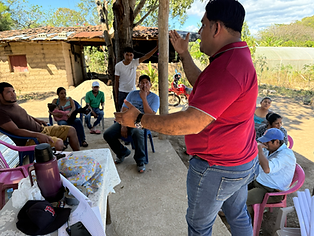
Las Brisas is a small rural community where this initiative began with the establishment of a layer shed with 100 hens. This effort was made possible through the guidance of Noel Sevilla, whose close relationship with beneficiary families has been key in building trust, strengthening participation, and supporting long term progress, alongside the support of the Lutheran Church of Nicaragua.


Noel Sevilla
Community Liaison
Lester Morales
Financial Consultant

Rigoberto Acuna
Project Supervisor

Angel Aragon
Diaconia Director
Egg production has provided an important source of protein, helping improve nutrition for children and families. At the same time, women involved in the program have developed new skills, increased their confidence, and contributed to their household income.
Through consistent support and strong local leadership, the program continues to grow, creating sustainable opportunities and reinforcing community development.
The vision for the Poultry Institute was inspired by Jim Plucker of Minnesota, an active board member of Helping Kids Round First and the driving force behind this initiative.
His commitment to sustainability, community empowerment, and practical agricultural solutions shaped the Institute’s foundation. Under his leadership, the Poultry Institute was designed not simply as a food production program, but as a pathway to:
Economic opportunity
Lasting community resilience

Measurable accountability
Self-reliance
What's our mission
To empower communities through sustainable poultry production models that create employment, increase food security, and promote economic independence.


What's our Vision
To develop a scalable and replicable agricultural model that transforms communities through responsible production, collaborative leadership, and sustainable growth.
Why Our Work Matters
Families in Madriz are not lacking effort, they are lacking access to structure. They farm small plots of land, work seasonal jobs, and do everything within their power to provide for their households. Yet income remains unstable, unpredictable, and often insufficient to create long-term security. Hard work alone, without systems and training, rarely produces sustainable growth.
The Poultry Institute exists to change that equation. Through financial literacy, hands-on poultry production training, measurable performance metrics, mentored entrepreneurship, and structured risk management, families gain more than birds, they gain a business framework. We replace uncertainty with clarity and volatility with systems, equipping families to move from survival to stability and from instability to measurable progress.

Our work is grounded in three core principles:
1. Stewardship
Families are trained to manage:
-
Feed costs
-
Mortality rates
-
Cash flow
-
Market timing
-
Profit reinvestment
" We teach stewardship, not dependency "
2. Multiplication
A single poultry cycle can become:
-
Emergency savings
-
Education funding
-
Housing improvements
-
Expanded production capacity
-
Community inspiration
" Small enterprises multiply impact. "
3. Dignity of Work
Families are not recipients. They are owners. Dignity returns when ownership is restored.
They:
-
Build their own poultry housing
-
Raise their own birds
-
Track their own financial performance
-
Sell their own product
Measurable Impact
The Poultry Institute operates with business discipline and defined performance targets.
Donors are not funding chickens.
They are funding:
-
Business systems
-
Training capacity
-
Entrepreneurial confidence
-
A scalable poverty-reduction model
Per Family (Annual Targets)

4–6 production cycles

400–2,000 birds per cycle

Target mortality rate under 5–7%

25–50% increase in disposable income within 12–18 months
_HEIC.png)
Community-Level Goals (5-Year Vision)

25–50 sustainable poultry families

Local trainers fully developed

Revolving input capital system established

Replicable “How-To” model documented for expansion